Low‑speed ABS Activation
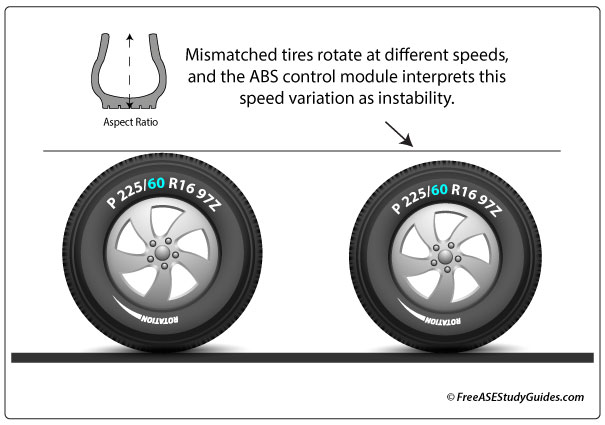
The ABS control module monitors each wheel’s rotational speed through its wheel speed sensor. While the system normally ignores small variations, it may intervene when one wheel begins spinning noticeably faster or slower than the others. Mismatched tires naturally rotate at different speeds, and the module can interpret this difference as instability. A smaller, lower‑profile tire will spin faster than a taller tire, and tires with significantly different tread depths can create the same effect. When these speed discrepancies exceed the system’s allowable threshold, the control module may activate the ABS in an attempt to correct what it perceives as a potential skid or lockup. Mismatched tires can place uneven loads on the drivetrain drivetrain components and the tires themselves.
Active Wheel Speed Sensors
ABS wheel speed sensor technology has evolved significantly over the years. Older vehicles commonly used passive wheel speed sensors, which generated an AC sine‑wave signal and were more susceptible to unwanted low‑speed ABS activation. Modern vehicles have largely transitioned to active wheel speed sensors, which produce a digital square‑wave signal and offer far better low‑speed detection and overall accuracy. As a result, active sensors greatly reduce the likelihood of false ABS activation at low speeds.
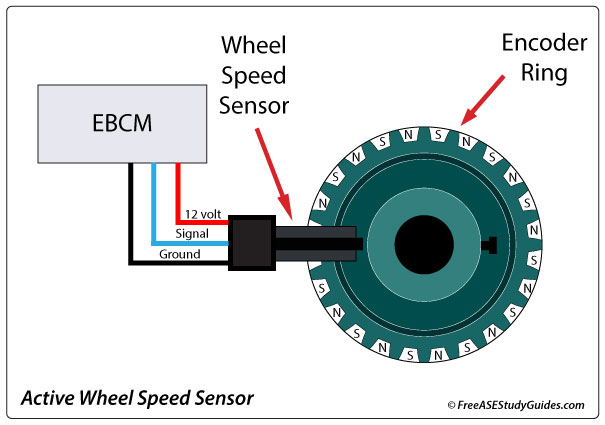
Active wheel speed sensors receive a 12‑volt supply from the control module on one wire and return a changing signal on the signal wire as the wheel rotates. The encoder ring is typically located inside the hub and uses a multi‑pole magnetic ring with alternating north‑ and south‑poled segments. This design allows active sensors to register wheel speeds down to 0 mph and detect reverse rotation. They generate a DC square‑wave signal and are installed on all four wheels of most modern vehicles.
Passive Wheel Speed Sensors
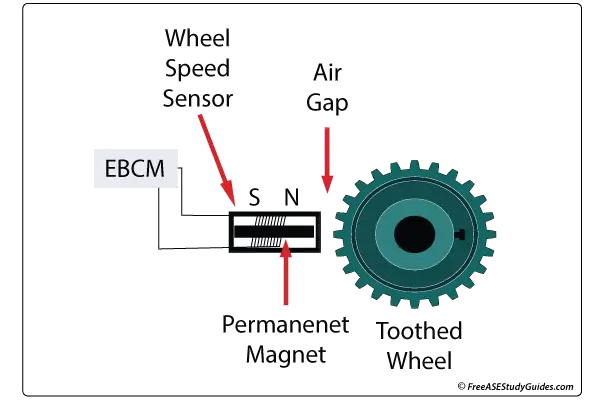
Passive wheel speed sensors, by contrast, produce an AC signal that appears as a sine wave on an oscilloscope. Although passive and active sensors may look similar externally, their operating principles are very different. Passive sensors are more common on older vehicles and rely on a toothed tone ring to induce voltage as the wheel turns.